
Key Takeaways
- AI vision models designed specifically for cinema match lighting, composition, and actors better than general image search.
- Cropping out TikTok/Reels UI, subtitles, and letterbox bars increases image search accuracy dramatically.
- Selecting frames with unique props, distinctive costumes, or prominent vehicles yields much better results than generic close-ups.
- Combine screenshot recognition with any vague plot memory in VidScio for instant verification.
Table of Contents
You saved an incredible film still on Twitter, saw an uncredited screenshot on Reddit, or snapped a photo of a movie playing on a plane. You have the picture, but you don't have the name.
Searching the web with an image used to require luck and obscure forum threads. Today, modern computer vision and multi-modal AI make it possible to identify movies, TV series, and anime from a single frame. Here is how to get an accurate result every time.
Why General Reverse Image Search Struggles with Film
Standard tools like Google Images or TinEye rely on pixel hashes and exact file matching. If your screenshot is taken from a different timestamp, compressed by social media, or resized, exact-hash engines fail.
Furthermore, search engines often index where the image was re-posted rather than what movie it depicts—sending you into endless loops of Pinterest pins or wallpaper galleries. That is why cinema-specific AI identification is necessary.
Step 1: Frame Selection (Choosing the Best Screenshot)
If you are extracting a still from a video clip, don't just grab the first frame. Look for high-information frames:
- Unique Sets and Architecture: A sci-fi hallway, a distinct diner, or a unique vehicle is far more identifiable than a plain bedroom or office.
- Clear Facial Views: Choose a frame where the main actor's face is in focus and well-lit without heavy motion blur.
- Distinct Costumes & Props: Period clothing, armor, uniforms, or signature accessories give AI models strong categorical signals.
Step 2: Clean and Crop the Image
Before uploading your screenshot, spend 5 seconds cropping it:
Remove Social Media UI: Crop out TikTok like buttons, username watermarks, and scrub bars.
Crop Black Bars: Remove letterbox borders so the image aspect ratio matches the original cinematography.
Avoid Obscuring Subtitles: If the subtitle text doesn't contain a quote from the movie, crop it to prevent OCR confusion.
Step 3: Identify with VidScio AI Visual Search
Once you have a clean frame, upload it directly to VidScio's AI Movie Identifier.
VidScio analyzes visual entities, matches actors and scene context against structured metadata (TMDB, IMDb), and returns verified movie matches along with:
- Exact title, release year, director, and cast.
- Rotten Tomatoes and IMDb ratings.
- Current streaming availability (Netflix, Prime, Max, Disney+) in your region.
- Direct option to save to your personal watchlist.
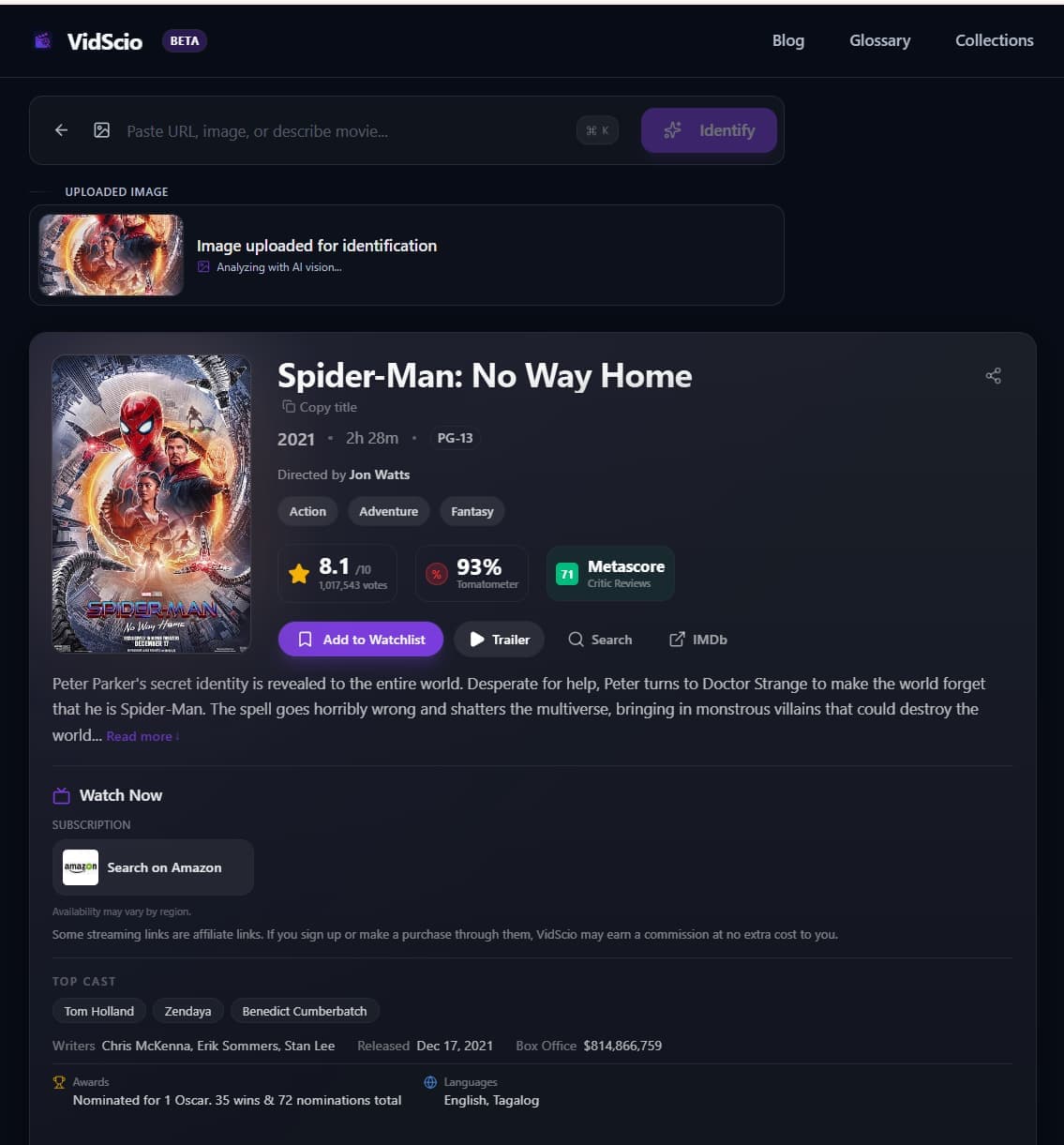
Step 4: Alternative Reverse Image Engines
If your screenshot is from an obscure foreign title or indie short, cross-referencing with other search engines can help:
- Yandex Images: Excellent at facial recognition across international and European films.
- Google Lens: Strong at identifying famous actors or distinct movie poster designs.
- trace.moe: The specialized standard for Japanese anime screenshots.
Frequently Asked Questions
Can I find a movie by uploading a screenshot?
Yes. Dedicated AI movie identification tools like VidScio analyze uploaded screenshot frames, match actor faces, costumes, set designs, and visual color palettes, and compare them against movie databases to identify the title.
Why doesn't Google Lens always find movie screenshots?
Google Lens is optimized for web images, products, landmarks, and celebrities rather than film scenes. A generic frame often points to wallpaper aggregators, Reddit reposts, or Pinterest boards instead of the canonical movie title.
How do I get the most accurate result from an image search?
Crop out letterbox black bars, subtitles, watermarks, and video player controls. Choose a frame that features distinctive visual elements like recognizable props, unique costumes, or clear faces.