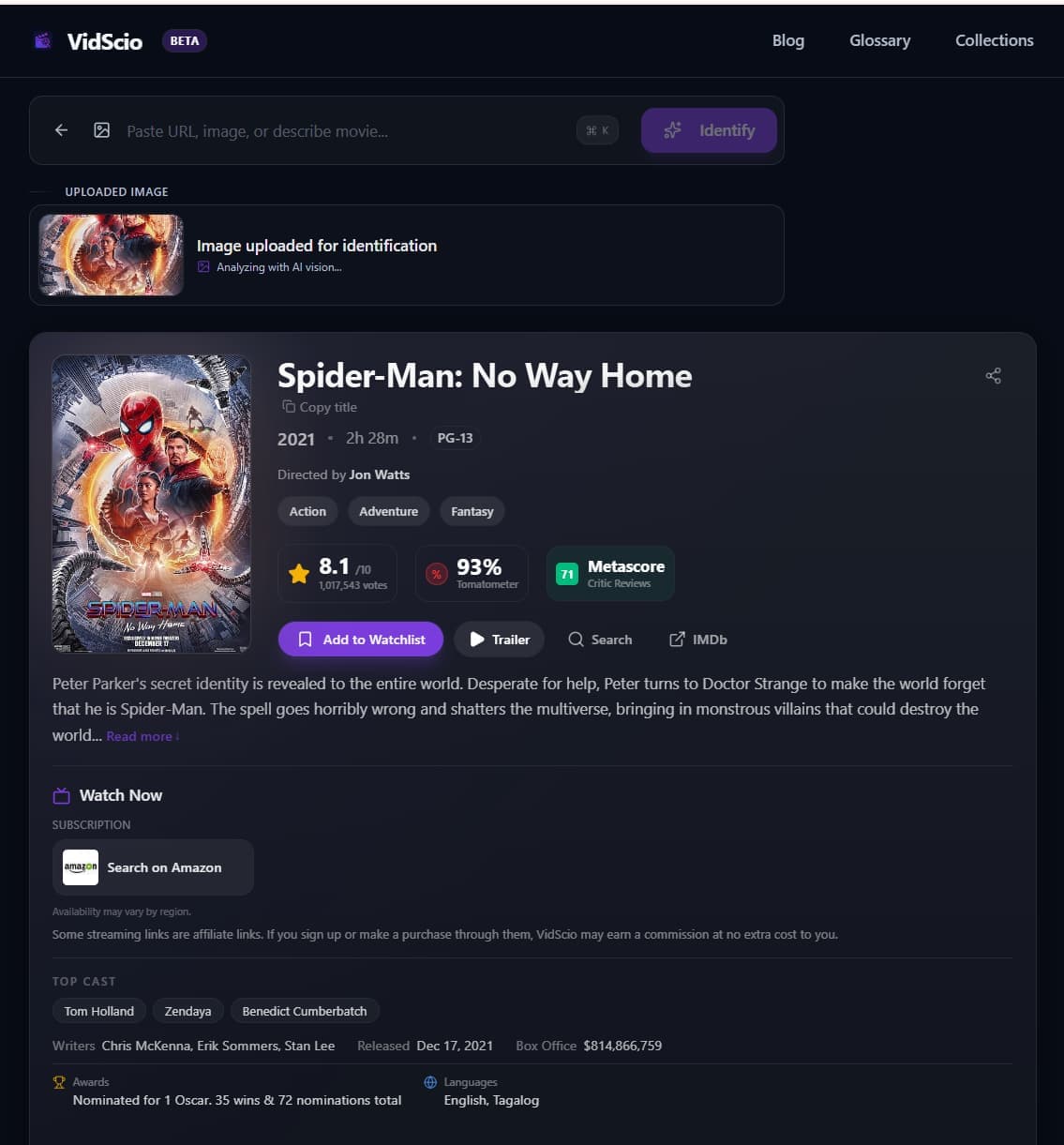
How often does a movie finder return a result in everyday use, and how long does it take? October's stored cohort includes 2,010 persisted successes and 5,337 tentative matches. Reporting both outcomes separately makes clear what the system recorded without treating a candidate as a verified answer.
Recorded outcomes by input
The success-return percentage counts only status = success with a non-null movie record. Tentative matches are recorded candidates with status = unverified_match. Unknown and restricted outcomes are separate. All percentages use eligible attempts as their denominator.
| Input | Attempts | Persisted success | Tentative | Unknown | Restricted | Success return | P50 | P90 |
|---|---|---|---|---|---|---|---|---|
| Image upload | 6,224 | 26 | 3,507 | 2,665 | 26 | 0.42% | 3.446 s | 7.649 s |
| YouTube URL | 2,971 | 1,616 | 307 | 1,048 | 0 | 54.39% | 8.062 s | 22.503 s |
| Other non-image input | 5,336 | 368 | 1,523 | 3,242 | 203 | 6.90% | 2.967 s | 6.360 s |
| All eligible attempts | 14,531 | 2,010 | 5,337 | 6,955 | 229 | 13.83% | 3.672 s | 12.732 s |
Image uploads recorded 26 persisted successes across 6,224 attempts (0.42%), alongside 3,507 tentative matches. That does not mean only 0.42% of images received a candidate, and it does not measure image-identification accuracy. YouTube's 54.39% success-return rate is also an operational outcome, not a correctness estimate. Nonrandom input mix and routing prevent a fair capability ranking between these groups.
Overall median response time was 3.672 s, with a P90 of 12.732 s. YouTube's P90 was 22.503 seconds. These stored durations include unsuccessful outcomes; they are not browser-measured page-load times or a promise about the next request.
What the cohort includes
- Window: October 1, 2026 at 00:00 UTC inclusive to November 1 at 00:00 UTC exclusive, using
identified_at. - Source: stored
identificationsrows withplatform = webappand no deletion timestamp. Chat and extension flows are outside this cohort. - 16,963 stored direct-finder rows, no deleted rows, then 2,431 cache hits excluded, followed by 1 correction retry among the remaining rows. This leaves 14,531 eligible attempts.
- Input grouping: image-upload flag first, then YouTube flag, then other non-image input. The last group includes descriptions and other links; it is not a text-only or social-link-specific measure.
- Latency: nonnegative stored milliseconds across every eligible outcome. Every eligible row has a latency sample. P50 and P90 use linear interpolation at
(n - 1) * percentile, rounded to the nearest millisecond. - Checks: cohort, input totals, status totals, and exclusions reconcile. There are no status/movie-record inconsistencies or null cache/correction flags in this snapshot.
Data and reproducibility
The aggregate was queried read-only on November 3, 2026. A single SQL statement used one database snapshot; a separate grouped query checked input outcomes. No user identifiers, submitted descriptions, links, or images are included in the download. Absent statuses are represented with explicit zero counts.
Download aggregate data (JSON)Why this is not a July trend line
The July field report recorded 17,485 eligible attempts, a 39.23% return rate, and a 3.499-second median. Those are historical operational measurements, not accuracy labels. October uses broader input groups, and historical deployment/status definitions have not been reconciled. Input mix, routing, persistence coverage, and latency methodology may differ. We do not interpret the two overall rates as evidence of improvement or decline.
Limitations
- No labeled ground truth or human correctness audit: these results cannot estimate accuracy, false positives, or competitor performance.
- Attempts are not unique people or unique problems. Repeat submissions, staff tests, and duplicate inputs are not separated.
- Only persisted rows are visible. Early failures, abandoned requests, unsupported-link recovery prompts, and flows that do not write this table can be absent.
- Deleted rows, cache hits, and correction retries are excluded. This cohort does not represent every visitor or identification interaction.
- Changing input mix and nonrandom routing prevent causal claims about models or product changes.
Use evidence, then verify the title
Keep a clear screenshot and any distinctive dialogue or scene context, then verify a suggested title against the original scene. Our screenshot guide and social-clip guide cover evidence collection and inaccessible links without assuming every clip can be identified.